
If you can fund only one thing in middle school ELA, fund this.
Most secondary literacy plans treat vocabulary as a supplement. Spelling lists on Monday, quizzes on Friday, a word wall in the back of the room. The research on what actually drives reading comprehension at the middle and high school level suggests a different posture: vocabulary, and specifically morphology-based vocabulary instruction, is not a supplement. It is one of the central engines of comprehension growth from grades four through twelve.
For administrators trying to decide where to put limited tier 1 dollars, this matters. Morphology is one of the few interventions in adolescent literacy that has both a strong research base and a low cost to implement well.
Why Morphology Matters More At Secondary
English changes texture between elementary and middle school. The texts students encounter in fourth grade are written largely in words students already know. The texts students encounter in seventh grade and beyond are not. Researchers studying secondary text complexity have estimated that 60 to 80 percent of the words students encounter in middle and high school texts are morphologically complex, meaning they contain identifiable prefixes, suffixes, and roots that, once known, unlock the meaning of thousands of related words.
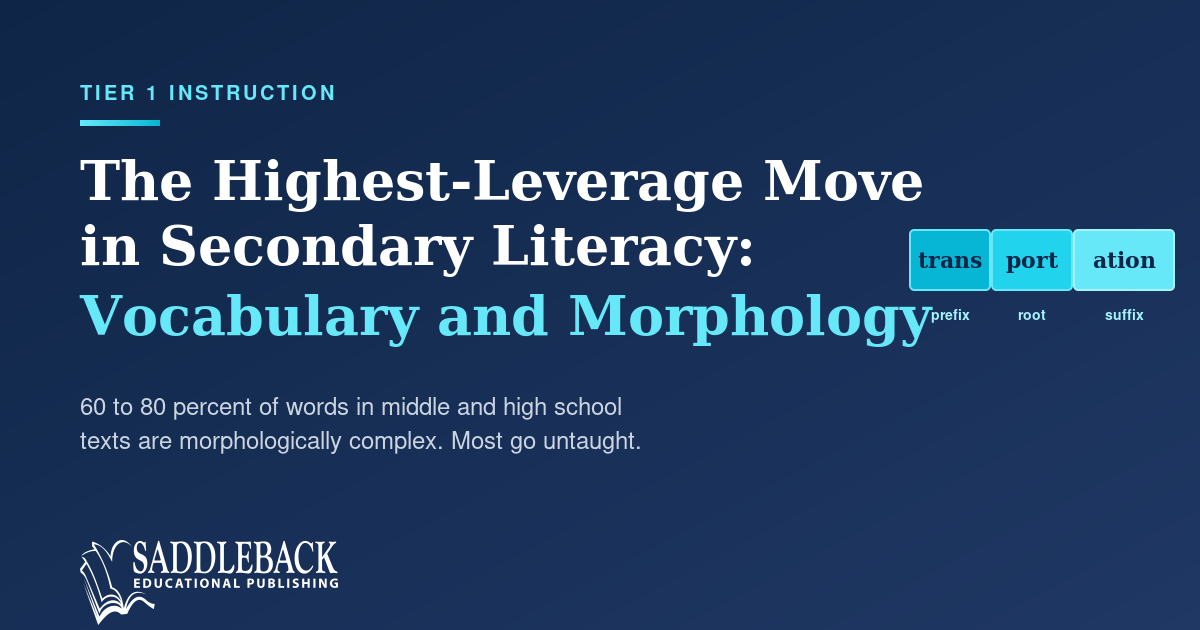
A student who knows the prefix "trans-" and the root "port" can attack "transportation," "transport," "portable," "import," "export," "porter," and "deportation" with at least partial confidence. A student who does not know either part has to memorize every word on its own. By high school, that gap becomes the gap.
What The Research Base Shows
The most cited researchers in this space include Amanda Goodwin at Vanderbilt and Devin Kearns at the University of Connecticut, whose collaborative and independent work on morphological problem-solving in adolescent readers has shaped the current consensus. A 2014 study published in Reading and Writing by Goodwin, Lipsky, and Ahn examined integrating morphological problem-solving within comprehension instruction for middle school students and found measurable gains in vocabulary, morphological awareness, and comprehension for treatment students.
A separate line of research, including Goodwin and Pacheco’s 2013 work in the Journal of Adolescent and Adult Literacy, examined how middle school students actually approach unknown morphologically complex words. The finding most useful to administrators: explicit instruction in morphological strategies produced meaningfully larger effects for language minority students, suggesting that morphology instruction is not only a comprehension lever but an equity lever.
Timothy Shanahan, in his 2025 article in the Journal of Adolescent and Adult Literacy, places morphology squarely at the center of tier 1 at secondary. The implication is a reordering of priorities for many districts: morphology becomes the default for all students, not a specialty add-on for some.
“Tier 1 instruction would focus on higher levels of structured literacy like morphology, while phonics instruction may be necessary for some students.”
Timothy Shanahan, Journal of Adolescent and Adult Literacy (2025)
What Morphology Instruction At Secondary Actually Looks Like
Strong morphology instruction does not require an expensive program. It requires consistency, sequence, and integration into the texts students are already reading.
- A consistent set of high-frequency Latin and Greek roots, prefixes, and suffixes taught explicitly across ELA and content classes, not just on ELA Mondays.
- Morphological problem-solving routines that ask students to break unknown words into parts, hypothesize meaning, and check against context. The routine is the instruction.
- Connections to spelling and writing, because morphological awareness improves both. The same prefix that unlocks "transport" should be in the writing prompts and the spelling pattern work.
- Integration with reading volume. Students need to encounter morphologically complex words in texts they can actually read, which is one of the operational arguments for accessible hi-lo and content-area materials in the intervention library.
Where Vocabulary Instruction Goes Wrong
The most common failure mode in secondary vocabulary instruction is volume over depth. A list of twenty isolated words per week, memorized for a quiz, and never used again does not change a student’s reading life. The research base, including the foundational work of Isabel Beck and Margaret McKeown on robust vocabulary instruction, has been consistent for decades: students need fewer words taught more deeply, used in multiple contexts, connected to morphological families, and revisited over time.
For administrators, this means a tier 1 vocabulary program should be evaluated not by how many words it lists, but by how it teaches the words it does include. Depth, repetition, transfer, and integration with morphology are the markers of a program that will move the needle.
What Administrators Can Do This Year
Three moves are within reach for most districts in the next twelve months.
- Audit your secondary ELA curriculum for explicit, sequenced morphology instruction. If it is not there, it is not happening.
- Train content-area teachers, especially science and social studies, in the high-frequency roots and affixes that appear in their disciplines. This is one of the highest-yield PD investments at secondary.
- Equip classroom libraries and intervention shelves with accessible texts that put morphologically complex vocabulary in front of students at their reading level. Saddleback’s hi-lo catalog is one option built specifically for this kind of integration, though the underlying principle, accessible text with rich academic language, applies regardless of vendor.
The Bottom Line
If you can fund only one thing in middle school ELA, fund explicit, sequenced, content-integrated vocabulary and morphology instruction. The research base is among the strongest in adolescent literacy, the cost is among the lowest, and the effect compounds across every text a student reads from sixth grade forward. For administrators looking for a high-leverage move that does not require a new program adoption, this is the one.
Sources
- Goodwin, A. P., Lipsky, M., and Ahn, S. (2015). Effectiveness of word solving: Integrating morphological problem-solving within comprehension instruction for middle school students. Reading and Writing. https://link.springer.com/article/10.1007/s11145-015-9581-0
- Pacheco, M. B., and Goodwin, A. P. (2013). Putting Two and Two Together: Middle School Students’ Morphological Problem-Solving Strategies for Unknown Words. Journal of Adolescent and Adult Literacy. https://eric.ed.gov/?id=EJ1013110
- Goodwin, A. P. et al. (2020). Multidimensional morphological assessment for middle school students. Journal of Research in Reading. https://onlinelibrary.wiley.com/doi/abs/10.1111/1467-9817.12335
- Shanahan, T. (2024). What role, if any, should phonics play in a middle school or high school? Journal of Adolescent and Adult Literacy. https://ila.onlinelibrary.wiley.com/doi/full/10.1002/jaal.1387
- Beck, I. L., McKeown, M. G., and Kucan, L. (2013). Bringing Words to Life: Robust Vocabulary Instruction. https://www.guilford.com/books/Bringing-Words-to-Life/Beck-McKeown-Kucan/9781462508167
- Saddleback Educational Publishing. https://www.sdlback.com/