
How to Choose CTE Reading Materials When High School Students Read Below Grade Level
Saddleback Educational Publishing calls the students it serves striving readers because they’re working hard to build their literacy skills. Many of these high school students are already developing hands-on skills in Career and Technical Education (CTE) courses such as automotive technology and construction, and career reading helps them connect that work to a future job.
For these students, choosing CTE reading materials starts with the career field and then the reading level. Saddleback followed that order when it developed its career handbooks for grades 9–12, writing one book per field at about a third-grade reading level.
“Not every student will go to college, and every student deserves to know what good career options are out there,” said Arianne McHugh, President and Publisher of Saddleback Educational Publishing. “Our CTE books introduce students to jobs that don’t require a four-year degree, show them what a day on the job looks like, and explain how to get there.”
Most high schools offer CTE. An August 2026 analysis by the Association for Career and Technical Education of nationally representative National Center for Education Statistics survey data found that 89% of high school counselors reported their school offers CTE. At schools that allow ninth graders to enroll, administrators report average ninth-grade CTE participation at 41%.
In 2024, only 3 in 10 eighth graders read at or above the NAEP Proficient level on the National Assessment of Educational Progress. Proficient is a demanding benchmark, and NAEP notes that it does not signify grade-level performance, which state assessments define. The national figure does not isolate CTE students, but it shows that many students enter high school still developing their reading skills and need materials that meet them where they are. CTE courses draw from that same group.
What Should CTE Reading Materials Include for Students Reading Below Grade Level?
Before committing to a career, students need a clear picture of the work, including what each role involves and what training it requires. Effective CTE reading materials present that information at an accessible reading level and introduce several roles within a field, since a student drawn to a field may be better suited to one role than another.
Saddleback developed its CTE Journeys Handbooks for these students. The series covers 16 career fields for grades 9–12 and focuses on careers that don’t require a four-year college degree. Each handbook is about 100 pages and ranges from Lexile® HL360L to HL560L. A handbook covers a field’s rewards and challenges, the roles within it, the skills and interests that suit those roles, and the education and training each path requires, along with next steps for students ready to move forward. A glossary at the back builds career vocabulary.
Real-world scenarios introduce readers to people at work and show what a typical day looks like. In Building, Construction, and Engineering, a scheduler coordinates supply shipments for a new high-rise from an office, while on-site, rough carpenters frame the building and a surveyor measures the land. Public Safety, Security, and Law introduces Andre, who has always wanted to be a firefighter, alongside two people who’ve built very different careers in the same field.
Students can put what they learn to work with Next Steps: Personal Exploration Guide, a 35-page consumable workbook designed to be used with the handbooks. As students choose a career path, plan for training, and prepare for their future, they identify their strengths and interests, map out budgets, research local employers, and analyze salary information. The guide also works for students whose plans fall outside technical careers. It is sold in packs of 10 and is also available bundled with the full handbook boxed set.
Which Career Fields Should CTE Reading Materials Cover?
CTE reading materials should cover the careers your pathways lead to, plus the ones students want to explore before they choose one. The table below groups Saddleback’s 16 handbooks by program area.
|
Program area |
CTE Journeys Handbooks
|
|---|---|
|
Trades and technical |
Auto and Equipment Mechanics; Building, Construction, and Engineering; Manufacturing; Transportation and Logistics; Agriculture, Food, and Natural Resources |
|
Health, safety, and public service |
Healthcare; Public Safety, Security, and Law; Government and Military; Education and Training |
|
Business and services |
Business Administration; Marketing and Sales; Hospitality and Tourism; Beauty and Cosmetology |
|
Creative and technology |
Art and Design; Media and Entertainment; Information Technology |
How Do You Check Whether a CTE Book’s Reading Level Fits Your Students?
Educators can check fit by comparing a student’s Lexile reader measure with a book’s Lexile text measure. Both use the same scale, so you can compare a student’s score on any school reading assessment that reports Lexile measures directly with the book’s. Many text measures carry an HL prefix, which stands for High-Low, the category Saddleback calls Hi-Lo. MetaMetrics, which publishes the Lexile Framework, assigns the HL code to books written to engage older students who need less complex text. The code signals that a book’s subject matter suits a teenager even when the text is written below grade level.
Measures vary across the CTE Journeys series: Building, Construction, and Engineering is HL450L, and Public Safety, Security, and Law is HL430L. In classes with a wide range of readers, teachers can steer students at the lower end toward the lower-measured titles among the fields they’re considering.
How Do You Match CTE Reading Materials to Each Program?
Matching reading materials to a CTE program starts with a school’s course offerings and ends with a plan for how students will apply what they read. The five steps below walk through that process.
- Start from the program: Identify the career fields your CTE courses prepare students for, and choose a handbook for each one. A construction course, for example, pairs with Building, Construction, and Engineering.
- Check the reading level against your students: Compare each student’s Lexile measure with the measure of the title they’ll read. Students who are still learning to decode, or sound out unfamiliar words, need phonics instruction alongside career reading. The school’s reading specialist can plan that support with resources such as phonics books written for tweens and teens.
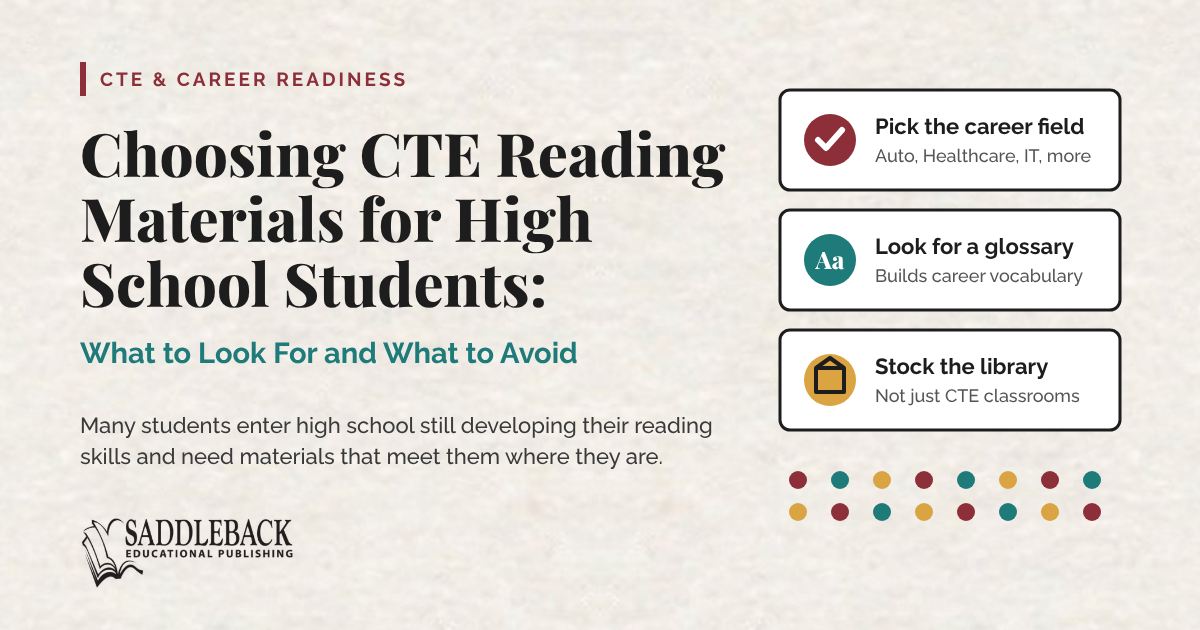
- Look for vocabulary support: Field-specific job titles such as “rough carpenter” and “surveyor” rarely appear outside the industry. A glossary gives students a quick way to check a term and keep reading.
- Confirm the book explains how to enter the career: A student weighing a field should know what education and training it takes before committing. Choose materials that lay out those requirements and the next steps toward each role.
- Give students a place to apply what they read: After reading about a field, students benefit from a structured way to test it against their own goals.
- Put the books where students will find them: Handbooks only help if students can reach them. Stock them in the school library as well as in CTE classrooms, so a student curious about a field can pick one up without waiting for an assignment. A set with one copy of each title covers every field in the library, and extra copies of the titles that match your busiest pathways serve the classroom.
How Does a Career Exploration Workbook Support CTE Reading Materials?
A career exploration workbook helps students turn what they learn about a field into a personal plan. Saddleback’s Next Steps: Personal Exploration Guide is a 35-page consumable workbook that takes students from choosing a career path to planning for life after high school. Students begin by identifying their strengths and interests, then research local employers and work through budgets and salary information.
Saddleback designed the workbook to accompany the CTE Journeys Handbooks, though it also suits students planning careers outside technical fields.
What Mistakes Should Schools Avoid When Buying CTE Reading Materials?
Schools that avoid the six mistakes below spend their budgets on materials students will read and use.
Starting with technical manuals instead of an accessible career overview
Publishers write technical manuals and certification study guides for adults who already work in a trade. Students new to a field need an overview first, so they reach those manuals already knowing the key vocabulary.
Choosing elementary career books instead of age-respectful books for teens
Elementary career books are easier to read, but their design and examples target younger children, and high school students notice. Books written for teens at an accessible reading level treat the reader as someone preparing to choose a career.
Buying single titles for each program without a full set for career exploration
Students often explore several fields before committing to one. A full set in exploration courses and the counseling office gives them access to every field, and each program can add single titles to its own collection as needed.
Keeping reading support out of CTE programs
Reading tied to a student’s chosen trade is part of CTE instruction. Schools can budget for reading materials alongside tools and equipment, and CTE teachers and reading specialists can select titles together.
Choosing by reading level alone
A book at the right Lexile measure can still go unread if its subject doesn’t interest the student. Choosing the field first, based on the course or the student’s interests, gives the book a better chance of engaging its reader. Every CTE Journeys title falls between HL360L and HL560L, so the field can lead the choice.
Ordering a single copy for the whole class
When a class shares one handbook, reading often turns into a teacher-led read-aloud. Students reading below grade level benefit from moving through the text at their own pace, so schools should order a copy for every student in the unit.
How Should a High School Order CTE Reading Materials?
Saddleback sells CTE Journeys Handbooks as individual titles by career field and as a boxed set with one copy of each of the 16 titles. Schools using the Next Steps workbook can order the boxed set together with a pack of 10 workbooks. Departments that also teach money management and workplace readiness can add Saddleback’s Life Skills Handbooks, part of the same Life & Work Ready line.
A single program can start with a class set of its field’s handbook and a Next Steps workbook for each student. In exploration courses and counseling offices, the boxed set also lets counselors share the relevant handbook with a student before a course-planning meeting. Educators can preview a free sample of the Building, Construction, and Engineering handbook before ordering.
Pairing that sample with students’ most recent Lexile measures provides schools with enough information to place an order.
Frequently Asked Questions
Can Perkins V funds be used to buy CTE reading materials?
It depends on state and district policy. Section 135 of the Strengthening Career and Technical Education for the 21st Century Act (Perkins V) lists appropriate equipment, technology, and instructional materials, including support for library resources, aligned with business and industry needs among the allowable local uses of funds. Purchases generally must address needs the district identified in its comprehensive local needs assessment, and Perkins funds must supplement state and local spending rather than replace it. Schools should review their state CTE office’s Perkins guidance or consult the district’s Perkins coordinator before ordering.
Are the CTE Journeys Handbooks fiction or nonfiction?
Nonfiction. Each handbook profiles a real career field, from the roles inside it to the training it requires.
Do the handbooks replace a CTE program’s technical textbooks?
No. The handbooks give students a career overview to read before or alongside a program’s technical textbooks. Each one introduces a career field and its key vocabulary in accessible text, so students are already familiar with the terminology when they encounter it in the program’s technical materials.
What should English Language Learners in CTE programs read?
Each handbook’s glossary defines field-specific terms, which helps English Language Learners and any other student new to a trade. Newcomers still building everyday English can start with Saddleback’s ELL and Newcomer libraries, written for that stage.